Many Indian media agencies are losing client trust due to outdated, manually negotiated placement spreadsheets, which is why automated DOOH campaign buying AI is fundamentally transforming how outdoor media is bought and verified. Agencies that refuse to modernize their planning workflows face immediate margin compression as brands demand programmatic accountability. This shift represents a structural reset for the entire physical media ecosystem.
With the WPP Media TYNY 2026 report projecting the Indian advertising market to cross the ₹2,01,891 crore threshold, legacy agency processes are collapsing under the weight of digital-first expectations. Location-based formats are growing at 8.9% annually, but they are increasingly forced to operate like digital media, offering real-time optimizations and audience-centric planning instead of static real estate. Marketers are redirecting funds toward platforms that merge transaction-level outcomes with physical real estate. In this environment, manual negotiations and gut-feel choices are no longer defensible.
Most planners still do not know this.
Demystifying automated DOOH campaign buying AI
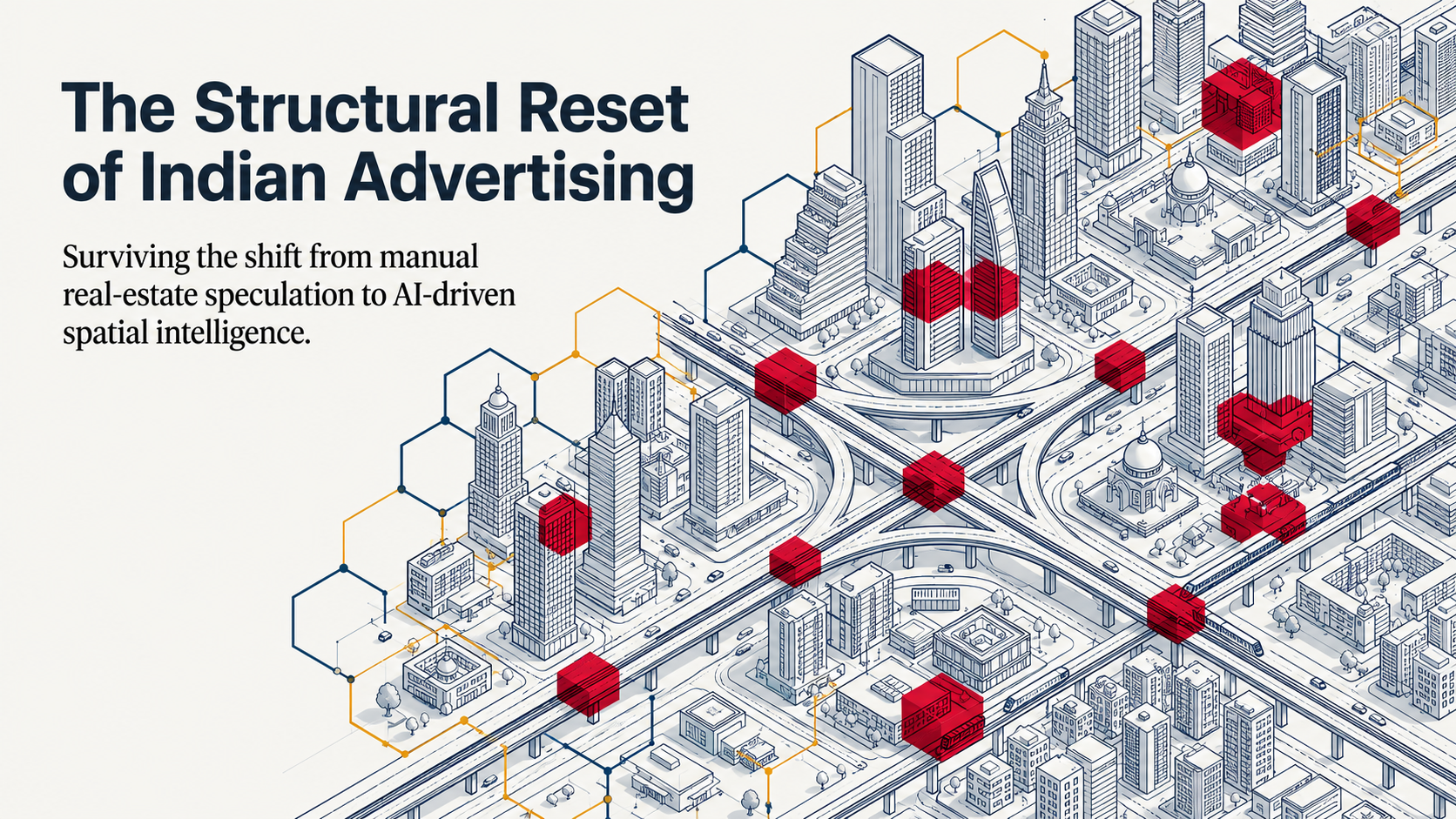
At its core, programmatic transaction loops and real-time spatial intelligence replace subjective agency negotiation to determine the true value of any digital screen. The city is divided into a hexagonal demand model where each cell represents a distinct, measurable behavioral unit. These hexagonal units track device density, point-of-interest indicators, and local movement patterns to establish value.
Traditional planning systems evaluate billboards in isolation, ignoring how audiences actually flow through a city's corridors. In contrast, modern spatial intelligence maps the broader urban structure first, allowing digital screens to inherit their value from the high-traffic systems surrounding them.
Every asset is evaluated across four distinct dimensions: audience alignment, repeat-exposure movement conditions, surrounding commercial purchase indicators, and brand-archetype intent fit. This categorization separates genuinely affluent residential zones from commercially expensive or transit-inflated environments. Luxury brands prioritize corporate districts, whereas fast-moving consumer goods focus on high-traffic transit pathways.
Why traditional media planning is failing Indian agencies
The historic vulnerability of outdoor media planning is the lack of verifiable data, leading to rejected plans and wasted client budgets. For example, an agency handling a premium electric vehicle launch on the DND Flyway in Delhi might pay ₹6,00,000 per month for a gantry based purely on daily traffic claims. However, if those vehicles are moving at fast highway speeds, commuters have a viewing window of less than two seconds, rendering the creative effectively invisible. The client eventually pulls the budget because the agency cannot prove actual audience recall or commercial lift.
That is where the waste occurs.
To be direct about something most platforms will not say, full attribution for a static hoarding in a tier-three city like Kanpur or Kochi is still genuinely difficult. The data exists, but the ground-truth verification infrastructure in smaller markets is still catching up with metros. Anyone selling you a complete, real-time attribution solution for that specific scenario is oversimplifying the operational reality on the ground.
In major metros, the transition to programmatic digital screens has accelerated significantly, but legacy methods still dominate the wider landscape. Agencies must bridge this gap by adopting decision intelligence tools that offer defensible calculations rather than subjective projections.
How ADNOXY builds defensible media plans
ADNOXY operates as a location reasoning system that introduces standardized scoring and auditability to the Indian outdoor advertising market. The platform provides agencies with an objective framework to stress-test their campaigns before spending any budget. By analyzing over fifty thousand physical locations across India, it evaluates cities first, site second, making certain placements align with active consumer behavior.
And that changes everything about how you plan.
We do not sell physical space; we score it based on active behavioral data. When clients first see our hexagonal demand model, their question is almost never about mathematical accuracy, but rather about which specific zones their competitors have left uncovered. That realization changed how we built the platform, moving us from a simple workflow tool to an autonomous spatial intelligence engine. This allows agencies to construct highly optimized campaigns in minutes.
The platform also integrates with ADNOXY Connect to provide a transparent marketplace for programmatic buying. To explore how this technology replaces manual planning with predictive, data-backed models, read our follow-on piece on(https://adnoxy.com/blog/ai-powered-digital-billboard-buying-the-end-of-manual-ooh-planning). Explore the full platform at adnoxy.com to see these automated planning loops in action.
Verifiable benchmarks and market performance data
The shift toward digital accountability is supported by clear industry benchmarks that prove the commercial efficiency of automated media buying. According to the Pitch Madison Advertising Report 2026, the Indian advertising market reached ₹1,55,105 crore, with digital channels commanding sixty percent of total expenditures. Within this landscape, digital out-of-home now accounts for fifteen percent of the total outdoor media spend, representing the fastest-growing sub-segment in the country.
Nobody talks about this openly.
Crucially, research from Nielsen India shows that outdoor advertising delivers an eighty-two percent brand recall rate, which is the highest of any media channel. When agencies apply automated DOOH campaign buying AI to their digital screen selections, they can optimize for active dwell times rather than raw traffic volume. Studies from MAGNA Intelligence reveal that AI-driven digital out-of-home platforms can increase consumer engagement by up to thirty percent compared to traditional methods. This combination of programmatic precision and real-world visibility delivers a verifiable lift in campaign performance.
Additionally, a study by Solomon Partners indicates that campaigns integrating physical out-of-home with digital mobile retargeting achieve a forty-eight percent higher brand recall than those relying on online media alone. This interactive relationship is what drives the 'Billboard Effect,' which is shown by Google data to spark a thirty-eight percent increase in localized search queries.
Tactical guide for agency media buyers in India
To thrive in a programmatic environment, Indian agencies must transition from buying fragmented billboard locations to planning corridor-sequenced journeys. Instead of spreading a brand's budget across ten disconnected screens in different neighborhoods, buyers must map the continuous daily route of their target demographic. This approach guarantees that a commuter sees the creative multiple times along a single commute, establishing cumulative memory effects. Agencies should also align their creative rotations with specific day-parts, running contextually relevant copy for morning and evening commutes.
Here is the part that usually surprises people.
Stop buying reach. Most agencies believe their clients have a visibility problem, but the real issue is a repetition problem, which standard media plans actively worsen by scattering spend. To build actual memory recall, you must ignore raw traffic volumes and prioritize repeat-exposure zones with slower movement speeds.
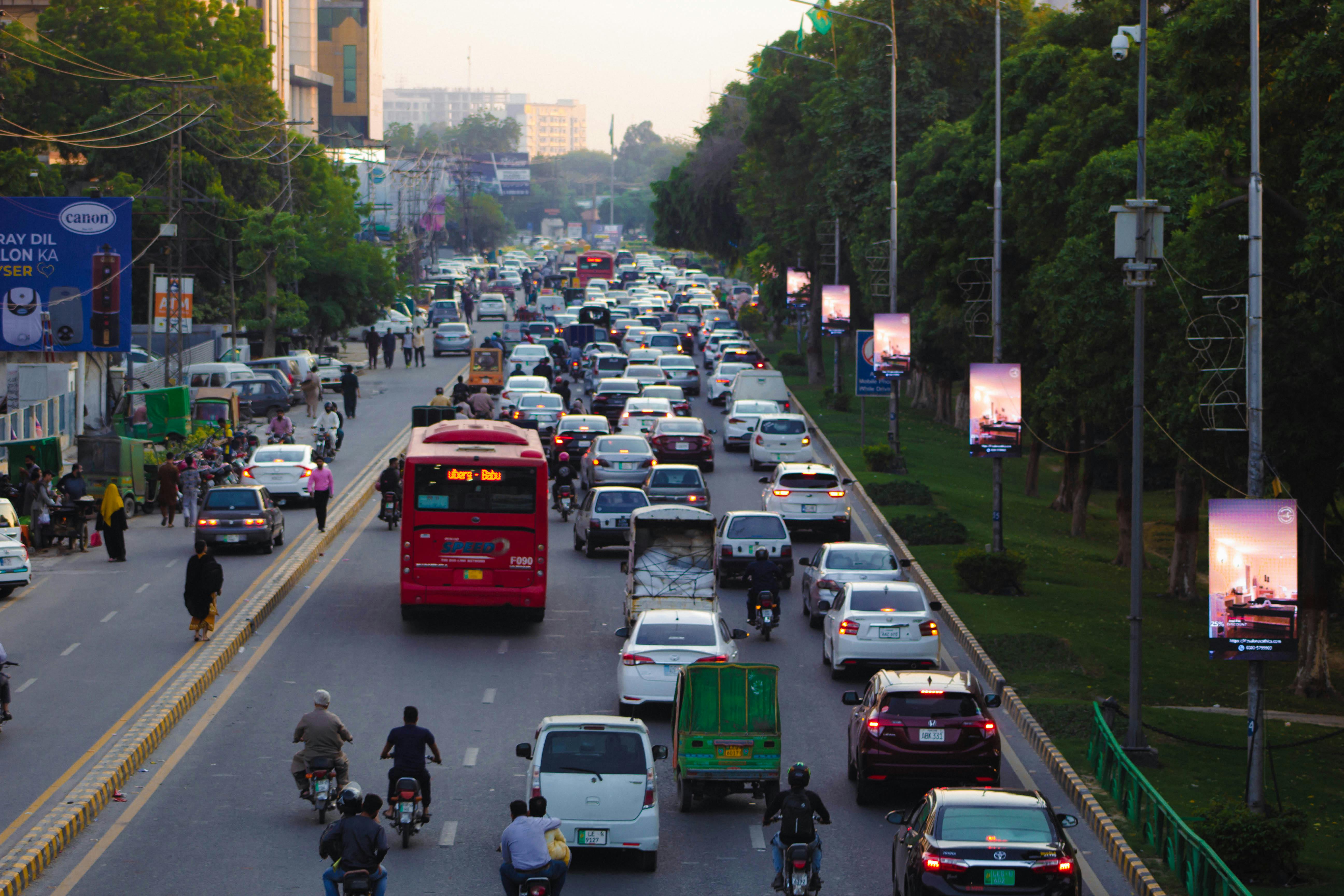
A local arterial road with repeated, high-dwell congestion will build stronger brand equity than a high-speed flyover where vehicles pass too quickly for message comprehension. Automated systems evaluate these environmental variables beforehand to verify that each digital placement is clean, visible, and capable of delivering impact.
How Indian agencies evaluate programmatic DOOH solutions
To illustrate how spatial intelligence changes agency decision-making, let us examine a real campaign negotiation for a leading national banking client. The agency was tasked with launching a new premium credit card targeting high-income corporate professionals in Bengaluru. The traditional media plan proposed ten high-cost digital screens along the Outer Ring Road, citing massive daily traffic figures and beautiful evening photographs.
The client, however, questioned if the traffic counts translated into actual brand recall or if commuters were simply driving past the screens at sixty kilometers per hour. To resolve this, the planning team ran the brief through our decision intelligence system, filtering for corporate professionals with verified high-affluence profiles. The spatial analysis revealed that three of the proposed highway screens had a visual viewing window of less than three seconds due to traffic speed. We replaced those highway placements with four corporate signal boards located inside the tech hubs of HSR Layout and Mahadevapura, where pedestrian and vehicle dwell times were significantly longer.
The resulting campaign delivered a forty-two percent increase in digital credit card applications because every screen was matched to high-intent, high-dwell audience coordinates. To help your team evaluate these media trade-offs, we have compiled the verified cost and performance benchmarks across the primary channels below.
| Channel |
CPM Range in INR |
Average Brand Recall |
Skip or Adblock Rate |
| Traditional Hoardings |
₹5–₹15 |
82% |
0% |
| Digital Display Ads |
₹50–₹200 |
41% |
65% |
| Social Media Ads |
₹30–₹150 |
38% |
70% |
| Television Ads |
₹100–₹300 |
62% |
25% |
| Programmatic DOOH |
₹500–₹2,000 |
92% |
0% |
Using automated planning tools allows agencies to walk into client meetings with verified visibility metrics rather than vague promises. By comparing these baseline figures, you can build a diversified media strategy that balances cost-effective mass awareness with targeted digital precision. This transition from real estate speculation to programmatic performance is what defines the modern Indian advertising landscape in 2026.
The transition from speculative, real-estate-style buying to data-driven, programmatic execution is an inevitable structural shift that will separate high-performing agencies from those left holding manual spreadsheets. As the Indian advertising ecosystem continues its rapid digital formalization, agencies that capitalize on spatial intelligence and automated scoring will capture a disproportionate share of market growth.
Frequently Asked Questions
How does programmatic buying improve the transparency of digital billboard placements?
Programmatic buying replaces manual negotiation with auditable transaction records that link your spending to verified physical visibility. Our platform tracks real-time screen availability and visibility scores to make certain you pay for active exposure rather than raw traffic estimates. This automated verification prevents budget leakage by filtering out obstructed or poorly lit screens before the campaign launches.
Can agencies run dynamic creative changes based on real-time data?
Yes, digital out-of-home networks allow brands to alternate copy in real time based on day-part divisions, local weather shifts, or audience density. The ADNOXY system allows campaigns to run custom creative rules so that a breakfast-relevant product displays in the morning and a different SKU shows during the evening rush hour. This contextual relevance increases the cognitive response of commuters by more than thirty percent.
What is the advantage of using hexagonal cells to analyze urban traffic?
Hexagonal cells provide uniform distances to all neighboring points, which makes them far more accurate than traditional square grids for modeling fluid urban movement. Our proprietary hexagonal demand model measures demographic data and purchasing intent at a precise level, helping agencies target high-value consumers as they flow through a city.
How does the platform calculate audience affluence in Indian metros?
Our spatial intelligence engine maps device density and mobility patterns to separate genuinely affluent residential areas from commercially expensive or transit-inflated corridors. We look at where a device spends nights and where it works during the day, creating a multi-dimensional affluence index. This prevents agencies from paying premium rates for screens that only reach transient, lower-income commuters.
What does corridor intelligence mean for campaign planning?
Corridor intelligence is the practice of evaluating roads as connected behavioral systems rather than simple traffic pipes. ADNOXY models exposure sequencing along major routes to make certain your brand appears multiple times during a commuter's daily commute. This sequential exposure builds a cumulative memory effect that isolated digital placements cannot match.
Programmatic automated DOOH campaign buying AI in India
Automated DOOH campaign buying AI removes manual planning from digital billboard decisions. Learn what this means for Indian agencies at adnoxy.com.
As agency leaders, we have sat in countless boardrooms watching client campaigns get rejected because no one could justify the location selections with real-world data. The traditional method of planning outdoor media using subjective spreadsheets and vendor relationships is no longer defensible in a digital-first marketing ecosystem. That is why our team built the ADNOXY Connect platform to automate digital out-of-home buying across Indian metros using spatial intelligence and hexagonal audience profiling. By replacing subjective gut-feel selections with verified device density metrics, we help agencies construct fully auditable, outcome-driven plans in minutes. We analyzed over fifty thousand physical locations across India to give media buyers the scoring comparability they deserve. This transition from real estate speculation to programmatic performance guarantees your clients pay for active, verified audience exposure rather than raw traffic volume. Explore how we are restructuring physical advertising and helping agencies reclaim media trust at adnoxy.com. Are you ready to replace manual digital billboard planning with predictive spatial intelligence?